

Common Chainsaw Issues
Chainsaws need regular maintenance to perform efficiently and safely during cutting tasks.
Refer to your owner's manual for guidance when working on your chainsaw. If you're unsure, take it to a repair centre.
Basic Checks
Checking the Fuel Supply
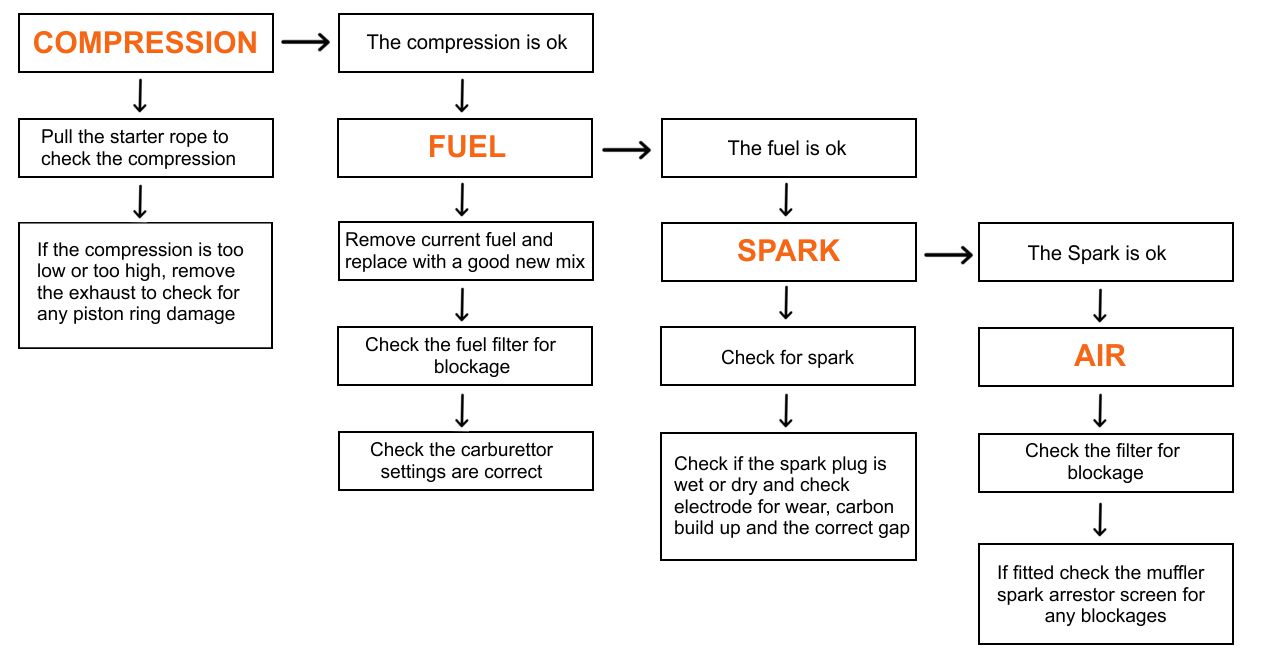
Check the fuel mix, look for blockages, and inspect the carburettor settings.
Start by emptying the fuel tank and refilling it with a high-quality fuel mix. If the chainsaw has been idle for a long time, the fuel may be contaminated. For guidance on the correct two-stroke mix ratio, see our guide here.
If there are blockages, such as in the fuel filter, a fuel system cleaner can help. Add the cleaner to the fuel tank and let it sit for several hours. Start the engine to circulate the cleaner, which will help clear any blockages.
The fuel filter feeds fuel from the tank to the engine, connecting to the internal fuel line to prevent contaminants like wood chips and dirt from entering. Check the fuel line for cracks or breaks, as it can become brittle over time.
To check the fuel filter, gently pull out a bit of the fuel line to expose it. If the filter is damaged or blocked, replace it by removing the old filter and twisting on a new one before reinserting it into the chainsaw housing.
Checking the Air Flow
Replace a blocked air filter, as it prevents contaminants from entering the combustion chamber. Use your manual to locate and inspect the filter for buildup.
While checking, inspect the muffler. Use compressed air to clear any carbon deposits after removing it from the engine. Also, check the muffler's spark arrestor screen to ensure it is clean and free from debris.
Finally, inspect all hoses and gaskets to ensure they are secure.
Checking for Spark
Without a spark, the fuel won't ignite, and the chainsaw won't start. Locate the spark plug, remove the cover and the spark plug from the cylinder, and attach the spark plug wire. Do not reinstall the spark plug into the cylinder! Touch the spark plug's electrode tip to a metal surface on the engine and pull the starter cord. If you see sparks, the spark plug is functioning. If not, check the electrode for carbon buildup, damage, or wear, and ensure the gap is correct. Clean the spark plug with a damp cloth, let it dry, and test again.
If the spark plug produces a spark but the chainsaw still has issues, check the gap. The gap between the ground electrode and the centre electrode should be appropriate; if it's too small, the spark may struggle to ignite the fuel-air mixture, and if it's too large, it will be hard for the spark to bridge the gap.
Electrodes wear down over time, increasing the gap and making it harder to start the chainsaw. If the gap appears too large, replace the spark plug.
Setting a chainsaw carburettor
Next, check the carburettor. Place the chainsaw on a stable surface, start it, and let it warm up for a few minutes. You'll find three adjustment screws next to the pull rope, each marked with a letter.
The screws adjust the carburettor: High (H), Low (L), and Idle (T). The H screw regulates the air-fuel mix at high RPMs, the L screw does the same at low RPMs, and the T screw controls fuel flow to the carburettor while idling.
L Screw - While the chainsaw is running, use a screwdriver to turn the L screw clockwise until the engine nearly stops. Then, slowly turn it counterclockwise until the engine idles smoothly. Rev the engine to check for a smooth response, making fine adjustments to the L screw as needed.
T Screw - The T screw adjusts the chainsaw's idle. Turn it clockwise until the chainsaw starts to move. Once it begins to move, turn the T screw counterclockwise until the chain stops. The engine should idle smoothly without the chain moving.