


Guide for NGK Spark Plug Numbering System
NGK has been advancing spark plug technology since 1930 and is the leading manufacturer of spark plugs for motorcycles, cars, horticulture, and various plant applications. They produce over 1000 different types of spark plugs, ensuring compatibility with the most demanding manufacturers’ specifications.
NGK spark plugs have two associated codes. The first is the spark plug number, which indicates the specifications of the plug. The second is the NGK stock number. For instance, the BPMR7A plug has a stock number of 4626. Both codes help identify the correct part, but only the spark plug number provides details about the plug itself. You can decode NGK spark plug codes to find suitable replacements or equivalents for your application.
The first part of the part code indicates the shell, thread, and pitch of the plug. The table above lists the most common thread sizes, but there may be additional variations specific to certain manufacturers’ applications.
The pitch measures the distance between a pair of thread peaks. Different models or machines may have thread exceptions. The thread reach measures from the plug base to the end of the thread.
The first part of the part number also indicates whether a spark plug has a tapered seat. The seat fits into the engine's cylinder head. Spark plug seats can be tapered/conical (no gasket or washer, direct contact with the cylinder head) or flat/gasket (gasket or washer seals between the plug and cylinder head).
This part of the part number also specifies the hexagonal nut size used to tighten or loosen the spark plug. These sizes are shown in both imperial and metric measurements.
For example, using the BPR6ES plug, we see that the 'B' specifies a shell size of 14mm x 13/16” with a pitch of 1.25mm.
The second part of the part number reveals the construction of the spark plug. This can consist of more than one letter if the spark plug has multiple attributes. In BPR6ES, ‘PR’ indicates that the plug is a Projected Insulator and Resistor type.
The third part of the part number indicates the intended heat range, shown on a scale from 2 (hottest) to 12 (coldest). In the case of BPR6ES, the ‘6’ signifies it is suitable for mid-range heat.
Following the number, the next letter(s) indicate the reach of the spark plug. The reach measures the distance from where the thread ends at the metal shell to the ground electrode at the end of the spark plug. The ‘E’ in BPR6ES indicates a reach of 19mm (¾”).
Next, we identify the firing end construction of the plug. The 'tip' or 'firing end' specifies the projection of the central electrode, which enhances combustion efficiency. There are four categories of tip/firing end:
Recessed – The firing end is within the shell, providing protection for racing engines and good vibration resistance.
Non-projected – The firing end is level with the end of the threaded shell. This relatively short tip offers good vibration resistance and thermal conduction from the electrode tip.
Projected – The centre electrode and insulator extend from the threaded shell, typically by 1.5mm. This design exposes the tip, producing a spark closer to the centre of the combustion chamber.
Extra projected – Similar to projected spark plugs, these can extend from 2.5mm to 10mm or longer. They are often designed for specific machine applications and may cause damage if not used correctly.
The terminal is where the plug cap connects to the plug. NGK spark plugs use different types of terminals:
Removable – These terminals can connect with or without a terminal nut. They may cause electrical issues if loose or damage the plug if too tight.
Solid/fixed/post terminal – This terminal has a fixed nut that cannot be removed without damaging the spark plug.
Threaded terminal – An exposed terminal thread.
Special/Stud – Terminals that do not fit other categories are special types of plugs, often used in miniature models and specific NGK designs.
In the case of BPR6ES, the ‘S’ indicates a Standard 2.5mm Copper Core C.E.
Finally, some spark plugs have an additional digit at the end of the part number, specifying the required gap size. For example, the NGK spark plug BKR6E-11 has a gap of 1.1mm (.044”).
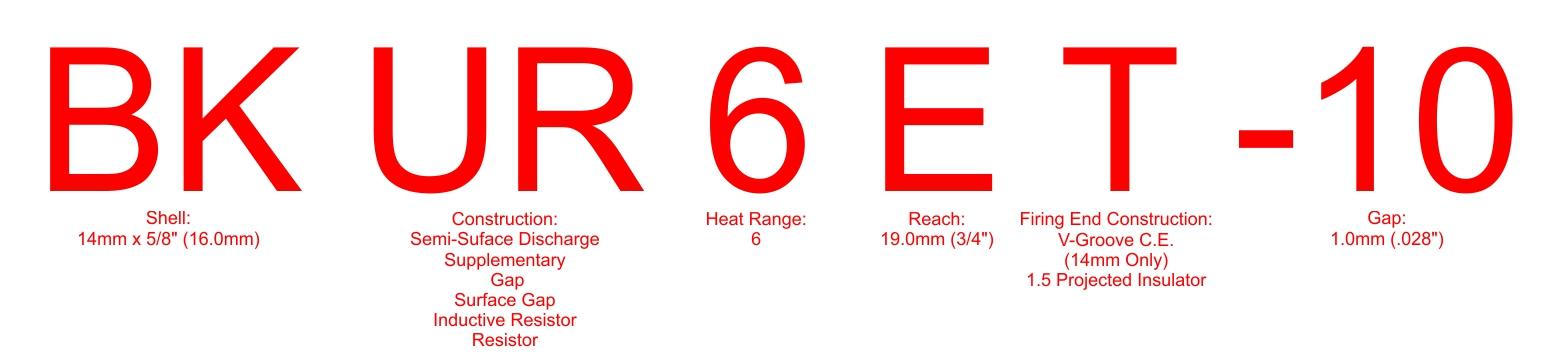
Below is an example of the specifications of a spark plug that has been decoded to reveal its specific features.
 ---
---