


Kubota Machine Model Numbers Explained
What Do Kubota Model Numbers Mean?
Whether you own a Kubota tractor, utility vehicle, mower or engine, the model number is the key to knowing exactly what you have. At first glance, these combinations of letters and numbers can seem confusing, but each part carries a specific meaning. Understanding how Kubota model numbers work makes it easier to order the correct parts, keep up with servicing, and recognise the capabilities of your machine across the entire Kubota range.
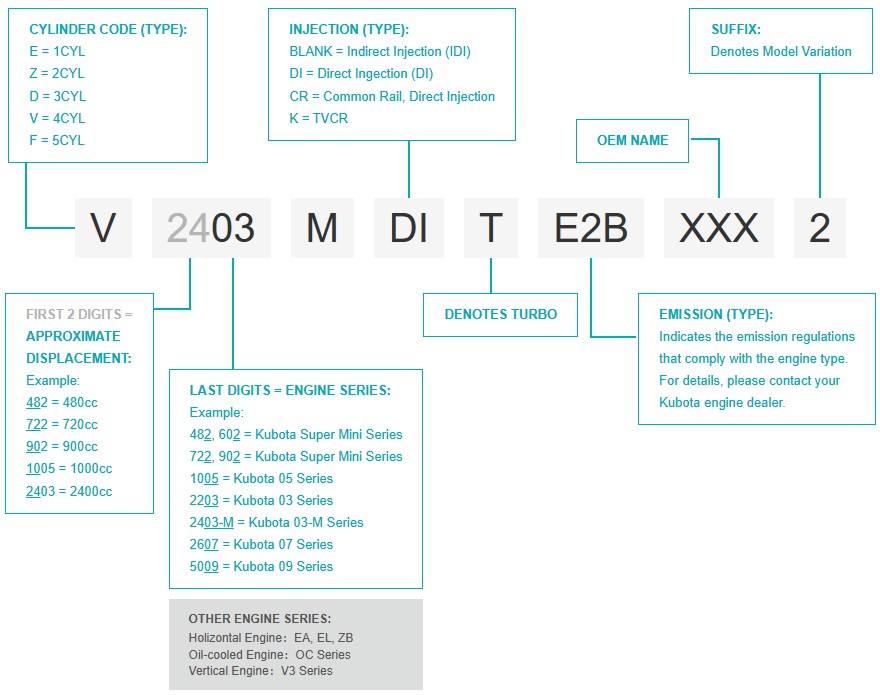
Kubota Diesel Engine Model Number Breakdown
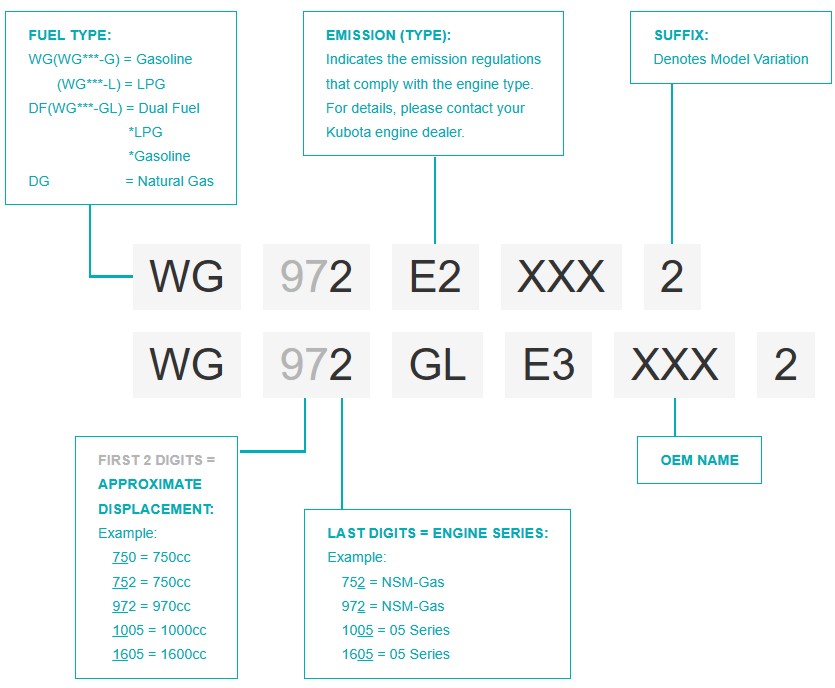
Every Kubota engine carries a model number, with each section identifying details such as cylinder count, displacement, series, injection type, and more. The breakdowns below show how to read these numbers for both diesel and petrol engines.
| Position | Section | What It Tells You |
| 1 | Cylinder Code |
First letter shows cylinder count:
|
| 2 | Displacement |
First two or three digits = approximate engine displacement in cc:
|
| 3 | Engine Series |
Last digits of displacement block indicate the engine series:
|
| 4 | Injection Type |
Injection system type:
|
| 5 | Turbo | “T” in the code shows the engine is turbocharged |
| 6 | Emission Type | Code indicating compliance with emissions regulations (varies by market) |
| 7 | OEM Name | Designation showing the engine is configured for a specific manufacturer/application |
| 8 | Suffix | Denotes model variation (e.g., production update, compliance change, or spec variation) |
Kubota Petrol Engine Model Number Breakdown
| Position | Section | What It Tells You |
| 1 | Fuel Type |
Prefix indicates fuel:
|
| 2 | Displacement |
First two digits = approximate engine displacement in cc:
|
| 3 | Engine Series |
Last digits of displacement block indicate the engine series:
|
| 4 | Emission Type | Code showing compliance with emissions regulations (varies by market) |
| 5 | OEM Name | Designation showing the engine is configured for a specific manufacturer/application |
| 6 | Suffix | Denotes model variation (e.g., production update, compliance change, or spec variation) |
What the Model Number on a Kubota Tractor Means
Kubota tractor model numbers might seem confusing at first glance, but once you understand the structure, they become a useful guide for identifying your tractor.
Breaking Down the Kubota Tractor Model Number
When looking at a Kubota tractor, the model number isn’t just a random mix of letters and digits. Each part of it has a meaning that helps identify the series, horsepower, and chassis type.
Every Kubota tractor model begins with a series prefix that identifies its class and general horsepower range. The most common examples are:
- B Series – Compact tractors, generally between 18–27 horsepower.
- L Series – Compact utility tractors, typically 24–48 horsepower.
- M Series – Full-size utility & agricultural tractors, ranging from 61–130 horsepower.
The BX Series (16–25 hp) refers to Kubota’s sub-compact tractors, the LX Series (25–40 hp) are compact tractors, and the MX Series (55–60 hp) are mid-size utility tractors. In these cases, the “X” indicates that the tractor belongs to a smaller, more compact version within its overall series.
After the series prefix comes the numerical part of the model, which gives further detail about the tractor:
- First number(s) – Show the approximate engine horsepower. For example, in L3901, the “39” represents around 39 horsepower, in B2650, the “26” represents around 26 horsepower, and in M7060, the “70” represents around 70 horsepower.
- Second number(s) – Indicate the chassis or frame type, which can differ between models or other design variations.
Kubota Tractor Model Variant Codes
| Letter Code | Description |
| C | Cab Model (e.g. M9000DTC) |
| D | Dual Traction (4WD) (e.g. M4500D) |
| DT | Dual Traction (4WD) (e.g. M9000DT) |
| E | Two-Wheel Drive (2WD) (e.g. B1550E) |
| F | Two-Wheel Drive (2WD) (e.g. M9000F) |
| H | High Clearance (e.g. M96SHDM) |
| HST | Hydrostatic Transmission (e.g. B7100HST) |
| L | Low Profile |
| M | Mudder (e.g. M9000DTM) |
| N | Narrow Tread (e.g. M5002N) |
| SU | Special Utility (e.g. M4030SU) |
| TLB | Tractor, Loader, Backhoe (e.g. L47TLB) |
Code Structure Guide:
- First letters: Transmission/Drive Type (D = Dual Traction, F = 2WD).
- Middle letters: Additional Features (C = Cab, N = Narrow, H = High Clearance).
- Trailing letters: Special Functions (B = Bi-Speed, A = Air Conditioning).
Additional Options:
Kubota tractors may include configuration codes commonly used in specs/manuals: A (Air Conditioning), B (Bi-Speed Turn), FST (Fully Synchronized Transmission), GST (Glide Shift Transmission), HC (High Clearance), SD (Swing-Shift Transmission), SS (Shuttle Shift Transmission), W (Wide Tread). These may not appear on the badge but are widely used to describe setup and functionality.
Kubota Mower Series Naming Conventions
Kubota mower model numbers may look complex at first glance, but they follow a clear logic. Each letter and number in a Kubota mower model has a purpose—indicating details such as horsepower, series type, or cutting width. The table below provides a breakdown of the main mower series, showing how to interpret their numbering logic, suffixes, and some example models.
| Series | Numbering Logic | Suffix | Examples |
| F / FZ / GF (Front-Mount) |
|
E = 2WD |
F2690 = 26 hp, generation 90 F3990 = 39 hp, generation 90 F3060 = 30 hp, generation 60 |
| G / GR / TG (Garden) |
|
LD = Low Dump HD = High Dump R = Rear Discharge |
G1700 = 17 hp GR2120 = 21 hp |
| SZ (Stand-On) | ≈ Horsepower class |
–36 = 36” deck –48 = 48” deck –52 = 52” deck |
SZ19-36 = 19 hp, 36” deck SZ26-52 = 26 hp, 52” deck |
| T (Lawn Tractors) |
|
KW = Kawasaki Engine BR = Briggs & Stratton Engine |
T2290 = 22 hp, generation 90 T1880 = 18 hp, generation 80 |
| W (Push Walk-Behind) | Last digits = deck size in inches | W5019 = 19” deck | |
| WG / WH / WHF (Large Walk-Behind) | ≈ Horsepower class |
–36 = 36” deck –48 = 48” deck –52 = 52” deck |
WG14-36 = 14 hp, 36” deck WHF19-52 = 19 hp, 52” deck |
| Z / ZG / ZD (Zero-Turn) |
|
E = 2WD L = Low profile R = Rear discharge F = ROPS KW = Kawasaki Engine BR = Briggs & Stratton Engine |
ZD18 = 18 hp ZG124E = ZG100 series, 24 hp ZD1211 = 1200 series |
Kubota Mini-Excavator Model Numbers Explained
Kubota mini-excavators are divided into two main categories based on their tail swing design. The K Series (K, KH-, KX-) uses a conventional tail swing, meaning the rear counterweight extends beyond the width of the tracks when the machine rotates. In contrast, the U Series features a zero or tight tail swing, where the rear of the machine stays within the track width during rotation.
Kubota RTV Model Code Structure
Each Kubota RTV model number is designed to convey key information, including the series, engine capacity, and configuration. Every RTV model begins with the “RTV” prefix, which stands for Rugged Terrain Vehicle. The “X” marks the X-Series generation. The numbers that follow indicate the engine capacity, such as the RTV-1100 (1,123 cc) and RTV-X900 (898 cc).
Suffix letters then show the trim or package:
- C – Cab
- W – Worksite
- R – Realtree camouflage
Understanding Kubota Loader Model Numbers
Kubota loader model numbers follow a simple pattern. The code always begins with “LA”, which identifies it as a loader attachment. The numbers that follow give an approximate indication of the loader’s lift capacity in kilograms. For example, a Kubota LA1154 loader is built with a lift rating close to 1,154 kg.
While the precise lifting capacity can vary depending on where it is measured (such as at the pivot pin, bucket centre, or lift height), the model number itself still provides a reliable guide to the loader’s overall strength.








© 2026 L&S Engineers Ltd. All Rights Reserved.
The UK's leading supplier of spare parts for plant hire, construction and groundcare since 1971.
Company No. 04224976.
eCommerce by AYKO
